
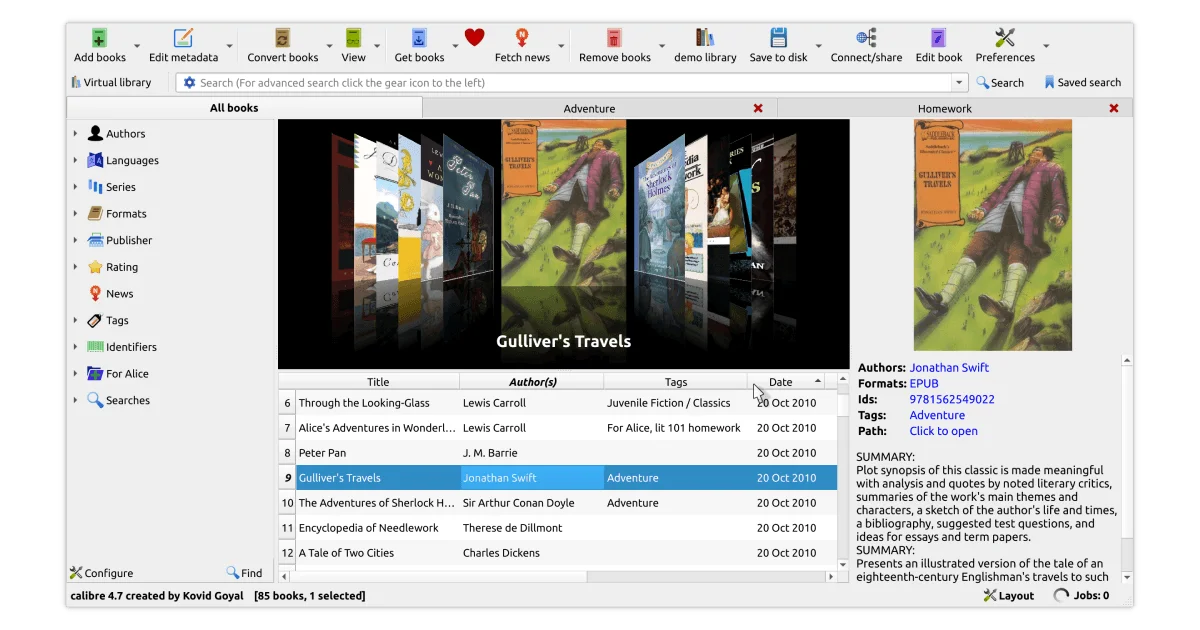
It starts innocently. You install Calibre, import a few dozen ebooks, and everything is tidy. Then you discover Project Gutenberg. Then a Humble Bundle with 30 programming books for $15. Then someone links you to Standard Ebooks. Six months later, you have 3,000 unorganized files, half of them titled things like ebook (1).epub and tor-book-something-final.epub, and the metadata is a disaster.
Calibre is the most powerful ebook management tool in existence, but its power is useless without a system. Here is one that actually works at scale.
Step 1: Fix the Metadata Before Anything Else
Metadata is the foundation. Every book needs a clean title, author, cover, and publication date before you do anything else. Garbage metadata makes the rest of the system impossible.
Select all books (Ctrl+A), then Edit metadata → Download metadata and covers (Ctrl+D). Calibre queries Amazon, Google Books, and other sources and fills in the gaps. This works for about 80% of books automatically.
For the remaining 20%, you have work to do. The most common failures: obscure academic books, foreign-language titles, and self-published works that were never listed on major retailers. Fix these by adding the ISBN manually — right-click the book, Edit metadata individually, paste the ISBN, and re-run the metadata download.
While you are fixing metadata, standardize author names. Calibre treats “Ursula K. Le Guin” and “Le Guin, Ursula K.” as the same author, but “Ursula K. LeGuin” (no space) or “Ursula Le Guin” (no middle initial) as different. Use Calibre’s author sort field to enforce consistency. Set the Author sort to Le Guin, Ursula K. format for all entries.
Step 2: Tags That Actually Work
Most Calibre users make the same mistake with tags: too many. Every imported book pulls in whatever tags the metadata source provided, and suddenly you have Fiction, fiction, FICTION, novel, Novels, Science Fiction, Sci-Fi, SciFi, SF, and Speculative Fiction all meaning roughly the same thing.
The fix: limit yourself to 10-15 top-level tags and be ruthless about consolidation. Here is a practical set:
Fiction/Nonfiction(these two tags cover 95% of books)Fiction → Sci-Fi,Fiction → Fantasy,Fiction → Literary,Fiction → MysteryNonfiction → History,Nonfiction → Science,Nonfiction → Tech,Nonfiction → PhilosophyTo Read,Reading,Read(tracking)
Calibre’s tag browser on the left lets you quickly rename or merge tags. Select the old tag, right-click, Rename, and enter the canonical version. Do this mercilessly. A library with 10 consistent tags is infinitely more useful than one with 200 auto-generated ones.
Step 3: Virtual Libraries for Separation of Concerns
A virtual library is a filtered view of your main library. It does not move or copy files — it just shows you a subset. This is the feature that makes Calibre scale.
Create virtual libraries for major categories:
- Reading Now (books you are actively reading)
- To Read (the queue)
- Reference (nonfiction, textbooks, manuals you keep for lookup rather than reading cover-to-cover)
- Archive (books you have read and will likely not re-read soon)
To create one: click the Virtual Library button (bottom of the tag browser), choose Create Virtual Library, and set the search expression (e.g., tags:"=To Read"). Your main library stays intact; the virtual library just gives you a cleaner view.
Step 4: File Naming and Storage
Calibre’s default file naming scheme (Author/Title (ID)/Title - Author.epub) is fine for internal use. If you export books to an e-reader, use Calibre’s Save to Disk or Send to Device features with a template that makes sense on the device.
For export, a good template is: {author_sort}/{title} - {authors}.{formats}
This gives you: Le Guin, Ursula K./The Left Hand of Darkness - Ursula K. Le Guin.epub
To set this: Preferences → Saving books to disk → Save template.
Step 5: Automation with Plugins
Once a library is organized, these Calibre plugins keep it that way with minimal effort:
- Find Duplicates: Scans by title, author, or ISBN and flags duplicates. Indispensable once a library passes a few hundred books.
- Quality Check: Scans for metadata problems — missing covers, bad ISBNs, empty author fields, inconsistent publication dates.
- Reading List: Maintains ordered lists of books. Useful for keeping a prioritized to-read queue separate from your full collection.
- Count Pages: Estimates page counts based on word count. Useful for deciding what to read next based on time commitment.
Run Find Duplicates and Quality Check once a month. Five minutes catches problems before they compound.
The Weekly Maintenance Habit
The difference between a library that stays organized and one that spirals into chaos is five minutes a week:
- Import new books (drag and drop into Calibre)
- Run metadata download on the new batch (Ctrl+D)
- Fix any misidentified books
- Add appropriate tags
- Move finished books from “Reading” to “Read”
If you do this every time you add books, the system never has a chance to break down. If you let 300 books pile up without metadata, you face a multi-hour cleanup session that most people will never do. Small, consistent effort is the whole game.
Frequently asked questions
How many books can Calibre handle before it becomes slow?
Calibre can handle 50,000+ books on a modern computer with an SSD. Performance depends more on metadata size than book count. Virtual libraries and saved searches keep performance snappy even with large libraries because they filter the view without duplicating data.
What is the best way to organize ebooks that have no metadata?
Use Calibre's bulk metadata download feature: select multiple books, press Ctrl+D (Cmd+D on Mac), and Calibre fetches titles, authors, covers, publication dates, and descriptions from Amazon, Google Books, and other sources automatically. For books it cannot identify, add ISBNs manually and re-run the download.
Can multiple people use the same Calibre library?
Calibre is not designed for multi-user access. The database locks when in use. For shared libraries, use Calibre-Web (a browser-based frontend) on a home server, or store the library in a cloud-synced folder and take care that only one person opens Calibre at a time.