
 Inksky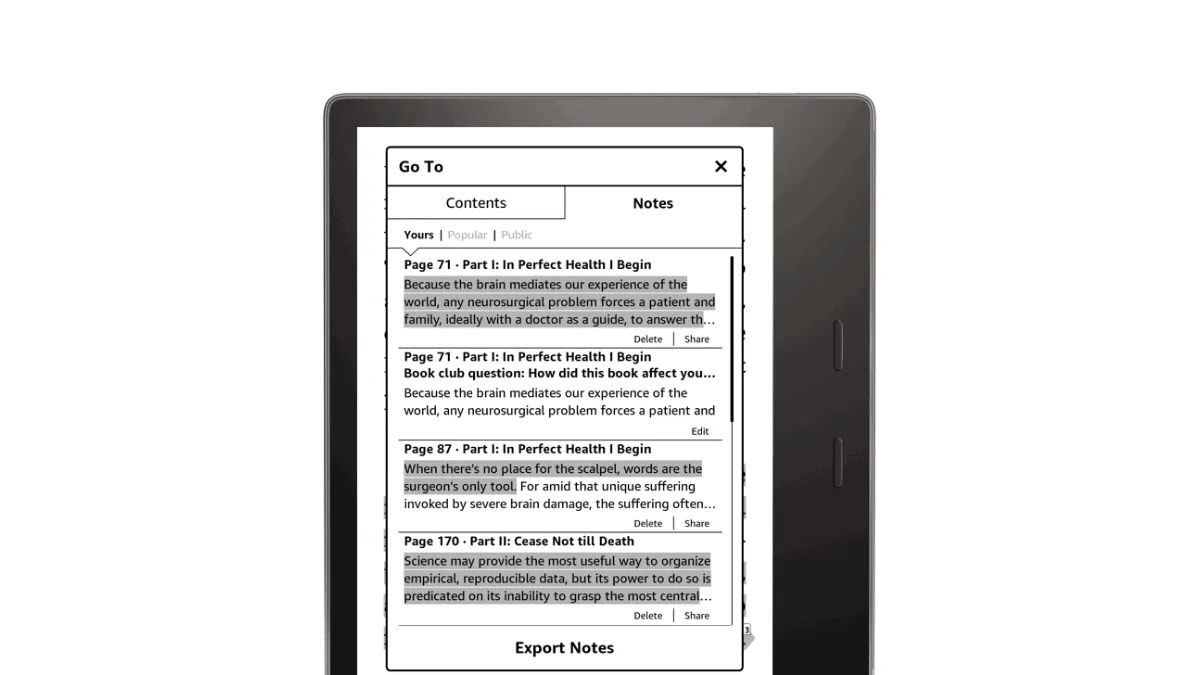
I highlight a lot. Hundreds of passages per book, sometimes. For years, those highlights just sat on my Kindle — a graveyard of yellow lines I never revisited. Getting them out of the device and into a system I actually use changed everything. Here’s how, from simplest to most powerful.
Method 1: The My Clippings file (direct, messy)
Every Kindle keeps a file called My Clippings.txt in the documents folder. Connect via USB, and it’s right there. It’s a flat text file where every highlight and note gets appended as you make it, formatted like:
Book Title (Author Name)
- Your Highlight on page 42 | Location 612-615 | Added on Monday, 15 July 2026 9:14:23 PM

The highlighted passage text here.
==========
The problems: no deduplication (highlight the same sentence twice, it appears twice), only location numbers (useless without the book open), and no chapter or section context. It’s a raw dump. For casual readers who highlight a few lines per book, it’s fine. For heavy annotators, it gets unwieldy fast.
If you’re comfortable with scripting, a Python script or a tool like Kindle Highlights can parse the clippings file into structured JSON or Markdown.
Method 2: Email export (clean, limited)
From your Kindle, open a book, tap the top of the screen, hit the notebook icon, then Export Notes. Amazon emails you a PDF and a CSV of that book’s highlights and notes. The formatting is clean, chapter-aware, and includes the full passage text with your annotations inline.
The catch: Amazon limits how much you can export at once. On longer books with heavy annotation, you’ll hit the cap — the export fails silently or truncates mid-file. For most books it works fine, but if you’re the type who highlights 200+ passages in a dense nonfiction book, you’ll need a different approach.
Method 3: Readwise (automated, paid)
Readwise is the gold standard. Connect your Amazon account once, and it auto-syncs every highlight — including sideloaded books sent via Send to Kindle — into a searchable library. From there, Readwise exports to Notion, Obsidian, Roam, Notion, Logseq, and Evernote. The killer feature is the daily review: Readwise surfaces 5-10 random highlights each day for spaced repetition, so you actually remember what you read instead of forgetting it six months later.
It’s $7.99/month (or $95.88/year), which stings if you’re not a heavy highlight user. But if annotating is part of your reading workflow, it pays for itself in time saved.
Method 4: Clippings.io (bulk export, web-based)
Clippings.io is a web tool that reads your My Clippings.txt file and lets you export all highlights to a single organized file — CSV, JSON, Excel, or directly to Evernote and Notion. It handles deduplication, groups by book, and preserves metadata. Free for basic exports; $2.49/month for direct cloud integrations.
Method 5: Bookcision (Mac-only, book-by-book)
Bookcision is a free Mac app that pulls highlights from the Kindle Cloud Reader web interface, book by book. It exports clean Markdown, plain text, or JSON. No import, no file parsing — it reads directly from Amazon’s cloud. The downside is it’s one book at a time, so if you want to export your entire library, it’ll take a while.
What I actually use
Readwise for automation. Every highlight from every book flows into my Obsidian vault without me touching anything. Daily review keeps the important stuff front of mind. For one-off exports (sharing a book’s notes with someone), the built-in email export is good enough. The My Clippings file is my backup of last resort — I check it quarterly to make sure nothing is getting lost.