
Ebook subscriptions are the Netflix of reading: pay a flat monthly fee and read as much as you want. But the devil is in the catalog details — each service has different strengths, and picking the wrong one means paying for books you cannot actually read on a device. Here is the complete breakdown.
Quick Comparison
| Service | Price | Library Size | Free Trial | Best For |
|---|---|---|---|---|
| Kindle Unlimited | $11.99/mo | ~4M titles | 30 days | Genre fiction, heavy readers |
| Kobo Plus | $9.99/mo | ~1.5M titles | 30 days | Kobo users, international |
| Scribd / Everand | $11.99/mo | ~1M titles + audiobooks | 30 days | Diverse readers, audiobooks |
| Audible Plus | $7.95/mo | Thousands | 30 days | Audio-first listeners |
| Amazon Prime Reading | Free w/ Prime | ~1K titles | N/A | Casual Prime members |
| Libby | Free | Library-dependent | N/A | Smartest readers |
Kindle Unlimited
Best for: Heavy genre fiction readers who own a Kindle.
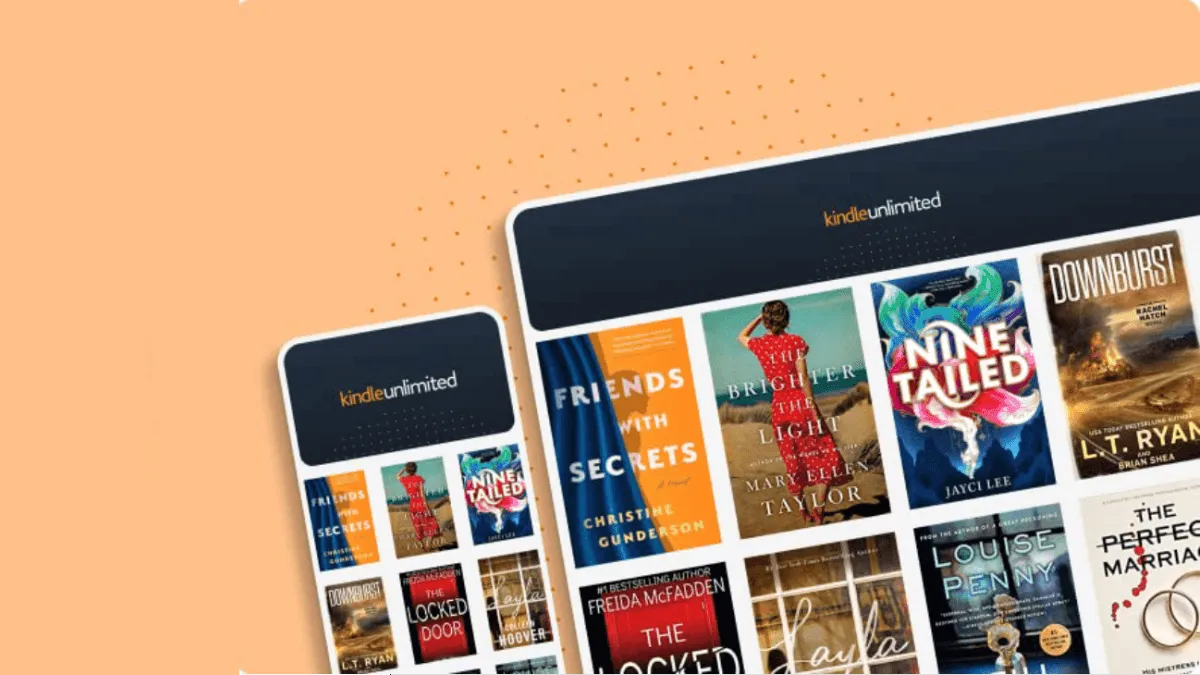
Kindle Unlimited claims over 4 million titles, but the Big 5 publishers are largely absent. The catalog is dominated by indie authors, especially in romance, thrillers, sci-fi, and fantasy. You will not find recent bestsellers from traditional publishers, but you will find an endless supply of solid midlist genre fiction. Audible narration is included on select titles — when you borrow a book with narration, the audiobook comes along seamlessly with Whispersync.
Pros: Largest selection, 20 books at a time, no throttling. Cons: Mostly indie titles, no new release bestsellers, locked to Kindle devices.
Is Kindle Unlimited worth it?
If you read 3+ genre novels per month, $11.99 works out to $4 or less per book — cheaper than buying individually. If you read 1-2 books per month or favor mainstream bestsellers, Libby plus selective purchases is more cost-effective.
Kobo Plus
Best for: Kobo users who want a more curated catalog.
At $9.99/month, Kobo Plus is cheaper than Kindle Unlimited by $24/year. The catalog (~1.5 million titles) has a more curated feel with a better mix of mid-list and international titles from Canadian and European publishers. Kobo Plus also offers a read-to-earn model that pays authors by minutes read, which some prefer over KU’s per-page model.
Kobo Plus has a separate $11.99/month tier that covers both ebooks and audiobooks. The audiobook selection is smaller than Audible but growing steadily.
Pros: Cheaper, better international availability, native Libby integration. Cons: Smaller catalog, Kobo-only, audiobook selection smaller than Audible.
Scribd / Everand
Best for: Readers who switch between books, audiobooks, and magazines.
Scribd (rebranded as Everand in 2024) takes a quality-over-quantity approach. Its catalog (~500K-1M titles) includes deals with major publishers like HarperCollins and Simon & Schuster. You get ebooks, audiobooks, magazines (Time, The Atlantic), and user-uploaded documents in one subscription.
The hidden catch: Scribd throttles heavy users. After reading 3-4 books or 2-3 audiobooks per month, your available titles silently shrink. Scribd calls this “rotating availability.” Users call it the reason they cancel. Kindle Unlimited has a hard 20-book cap but no throttling — what you see is always available.
Critical limitation: Scribd does not work on e-ink Kindles or Kobos. You can only read through the phone/tablet app or an Android e-reader like Boox.
Audible Plus
Best for: Audio-first listeners.
At $7.95/month, Audible Plus gives unlimited streaming from a curated catalog of thousands of audiobooks, podcasts, and Originals. No credits — just stream or download anything in the Plus catalog. The Audible app has best-in-class playback: variable speed, sleep timer, clipping, and cross-device sync.
Kindle Unlimited’s audiobook feature is a bonus, not a dedicated service. Only a fraction of KU’s 4 million titles include narration, and you cannot browse by audiobook availability. If you primarily listen, the $7.95 Audible Plus plan is a better deal than KU at $11.99.
Strategy: Some readers pair Audible Plus ($7.95) with free Libby for ebooks. That combination costs less than Kindle Unlimited and gives a superior audiobook experience alongside free library books.
Libby: The Free Option
Your local library card is the most cost-effective subscription. Libby connects to a library’s OverDrive collection, giving you free ebooks and audiobooks for 21-day loans. Books auto-return, so no late fees.
Libby’s catalog is curated by actual librarians and includes mainstream bestsellers, new releases, and literary fiction — the books often missing from Kindle Unlimited’s indie-heavy catalog.
The trade-off: wait times. Popular titles can have hold lists of weeks or months. The solution: get multiple library cards. Many libraries offer non-resident cards (sometimes for a small fee) that multiply your reach and shorten waits.
Amazon Prime Reading
If you already have Amazon Prime, you get Prime Reading for free. It is a rotating selection of about 1,000 titles plus magazines and Amazon Originals. Borrow up to 10 books at a time.
Prime Reading is a nice perk — not a reason to get Prime, but a reason to check what is available if you already have it. For 1-2 books per month, Prime Reading alone may be enough. For heavier readers, it pairs well with Kindle Unlimited.
The Combo Strategy
The smartest approach for most readers:
- Start with Libby. Check a library first. Place holds on popular books and let them arrive naturally.
- Subscribe during droughts. If holds are taking too long, subscribe to KU or Kobo Plus for a month or two.
- Rotate freely. Neither service requires a contract. Rotate between Libby-only months and subscription months to keep your pipeline full at minimal cost.
Which Should You Choose?
| Reader Type | Best Option |
|---|---|
| Kindle user, 3+ genre novels/month | Kindle Unlimited |
| Kobo user, library reader | Kobo Plus |
| Reads across formats (books, audio, magazines) | Scribd |
| Audio-first listener | Audible Plus |
| Already has Prime, casual reader | Prime Reading (free) |
| Wants bestsellers, price-sensitive | Libby (free) + selective purchases |
Frequently Asked Questions
Is Kindle Unlimited worth it in 2026?
That depends on reading volume. At $11.99/month, if you read 3+ genre novels per month, you are paying under $4 per book. If you read 1-2 books per month or prefer mainstream bestsellers, Libby plus selective purchases costs less. The catalog is ~80% indie titles — if the books you want are not in KU, the price per book stops mattering.
Can I use Kindle Unlimited on a Kobo?
No. Kindle Unlimited is locked to Kindle devices and the Kindle app. You cannot read KU books on a Kobo, PocketBook, or other non-Amazon reader. Kobo Plus is the equivalent subscription for Kobo devices. If you want to use both subscriptions, consider a Boox Android e-reader, which can run both the Kindle and Kobo apps.
What is the cheapest ebook subscription?
Libby is free with a library card. Among paid services, Kobo Plus at $9.99/month is the cheapest unlimited option. Audible Plus is $7.95/month but is audiobook-only with a much smaller catalog. Amazon Prime Reading is free if you already pay for Prime.
Does Scribd still throttle users?
Yes. Scribd (Everand) limits heavy users by silently removing available titles after 3-4 books per month. They call this “rotating availability.” Kindle Unlimited caps at 20 books but does not hide titles — what is in the catalog is always available.
How do I get multiple library cards for Libby?
Many public libraries offer non-resident cards for a small annual fee (typically $25-50/year). Some allow online registration. Check libraries in large metro areas (Brooklyn, Los Angeles, Houston) and statewide systems. Multiple cards multiply a available catalog and shorten hold times on popular titles.